

As the Humanities Council’s Program in European Cultural Studies (ECS) celebrated its 50th anniversary, Dipesh Chakrabarty (University of Chicago), was invited to be this year’s Faber Lecturer. That his February 2026 visit corresponded with the semicentennial anniversary was no coincidence.
A 50th anniversary archival project undertaken earlier this year, spearheaded by Director of ECS Spyros Papapetros (Architecture), produced an abundance of historical information about the origins of ECS, parts of which were presented in Papapetros’s opening remarks to Chakrabarty’s lecture following a welcome by former ECS Director Brigid Doherty (German and Art & Archaeology).
The efforts of ECS founding director Carl Schorske and later initiatives to de-center cultural studies from a Western perspective “signal that there was and will always be space for rigorous historical critique of European culture within a program in European Studies,” Papapetros noted in his remarks. He then invited ECS Executive Committee member Rubén Gallo (Spanish and Portuguese) to introduce the speaker. Gallo offered a concise overview of Chakrabarty’s historiographic work from postcolonial to environmental histories, including his recent reflections on the effects of climate change in his 2021 book The Climate of History in a Planetary Age.
As part of his Faber visit, Chakrabarty led, earlier in the day, a lunchtime seminar focusing on a recent unpublished paper of his on the culture of “longevity,” which he generously shared and discussed with undergraduate students in the European Studies minor and a group of ECS Graduate Affiliates. Chakraborty forewarned that recent efforts towards the prolongation of life in elite sections of Western societies occur at the expense of less privileged segments of the earth’s human population and non-human species.
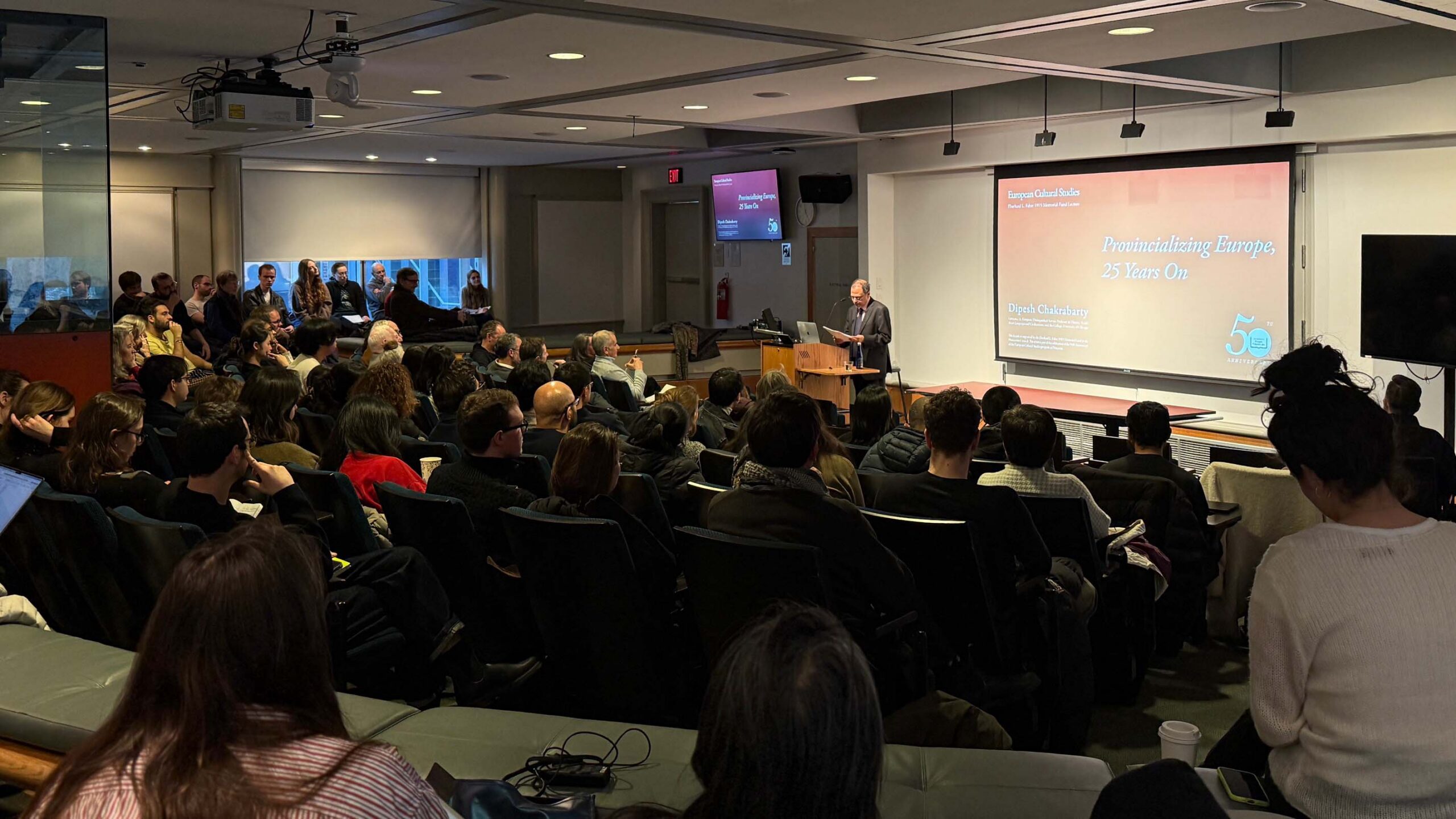
In his evening lecture in Betts Auditorium, Chakrabarty took a retrospective look at the origins and reception of his groundbreaking book Provincializing Europe: Postcolonial Thought and Historical Differencefirst published in 2000 and republished with a new preface in 2007. Chakrabarty discussed why and how an intellectual project such as “provincializing Europe” emerged at the turn of the century from the insurgent historiography of Subaltern Studies, a series of publications on colonial South Asia (1982-2005) inspired and led by Ranajit Guha (1923-2023). What was the “Europe” the book sought to provincialize? What did it mean to “provincialize” this Europe? What was the significance of this exercise and what might be the relevance of such a project today?
Disputing the assumption that Europe represents the sole path to modernity, Chakrabarty reflected on ways that the rest of the world can untangle itself from this Western perspective and instead root themselves in their own diverse histories in relation to Europe. Extending the historical arguments foregrounded in his 2000 book to current affairs, Chakrabarty concluded his talk by laying out the three big crises in the 21st century that humanity faces nowadays: climate change, AI and the future of work, as well as the falling birth rate and the future of the urban species. To address this three-pronged new reality, he argues that we need to acknowledge the “funding violence” that allowed humanity in a global context to be modernized and confront the “entanglement” of such violence in the post-colonial world. While acknowledging the “unassimilability of the other,” Chakrabarty also asked us to recognize that “you are entangled with the other, but we don’t have a single framework that will sublate everything into oneness.”