

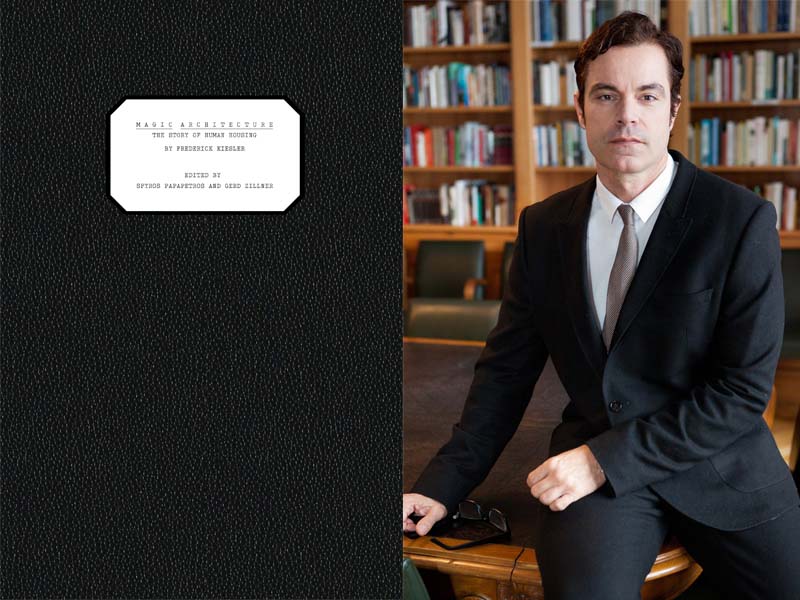
Spyros Papapetros is associate professor of architecture and director of the Humanities Council’s Program in European Cultural Studies. Along with Gerd Zillner (Kiesler Foundation), he edited “Magic Architecture,” the first publication of a manuscript by artist and architect Frederick Kiesler written in the mid-1940s. It was published by MIT Press in November 2025.
How did you get the idea for this project?
This project owes its origin to a series of suggestive coincidences. In December 2013, I was in Vienna to present a paper at a symposium at the Sigmund Freud Museum, where I met the incoming director of the museum, Monika Pessler, who also happened to be the outgoing director of the Kiesler Foundation—a small study center that houses the archive of Austrian-US émigré architect, artist, designer, and theorist Frederick Kiesler (1890-1965). At the end of the symposium, I mentioned to Monika that I always wanted to study Kiesler’s book manuscript, “Magic Architecture,” whose striking title many had heard but its contents no one had read. “Will you still be in Vienna tomorrow?” “Of course!” I responded and proceeded to change my early morning flight to an evening one so I could pay a visit to the Foundation and have a first look at the 300-page manuscript.
Given my interest in prehistory and the limited time I had, I started with Kiesler’s brief chapter on “the cave” as the first human shelter. For Kiesler, the cave is essentially a psychological enclosure humans never abandon but keep carrying with them as a portable device that eventually transmogrifies into a tent. “Take that Plato!” I thought. Per Kiesler, and contrary to Western metaphysics, one never leaves the cave but keeps living in its endless interior that knows no difference between inside and outside, darkness and enlightenment.
It was also the first time I met Gerd Zillner, who would later become the director of the Kiesler Foundation and my indispensable collaborator in the multi-year enterprise of publishing this incomplete manuscript and bringing it back to life.
How did the project develop or change throughout the research and writing process?
There were countless more visits to the Kiesler Foundation in the following 10 years, where Gerd and I gradually discovered that what initially appeared as a single typescript had multiple earlier manuscript versions by the hand of the architect, containing text that was consequently erased or significantly altered and which is now restored in the critical edition that was just published.
We also discovered that large parts of Kiesler’s “story of human housing” contained long quotations from the works of early 20th century anthropologists, ethnologists, archaeologists, evolutionary biologists, and cultural historians that the architect and his wife, Stefi Kiesler, transcribed and translated from German publications and which, in our edition, are compiled in an appendix. One of the most gratifying aspects of the research was disclosing the previously unacknowledged role of Stefi Kiesler, an artist employed as a librarian at the New York Public Library, who not only typed and organized the entire manuscript but also conducted part of the original research for the text and illustrations of “Magic Architecture.”
What questions for future investigation has the project sparked?
We hope that the long-awaited publication of “Magic Architecture,” perhaps the first twentieth century architectural text to describe the origins of human housing from an anthropological perspective, can inspire further discussions on the relation between ecology and habitat in the century in which Kiesler’s treatise is finally published.
We also hope that the critical edition of the text – with its long introduction outlining the architect’s sources along with the social, cultural, and political context in which it was written, plus the elaborate annotations and the appendix of the architect’s bibliographies and list of sources for more than 300 images montaged in the book’s 70 plates – will establish a new type of book publication in architectural literature.
Why should people read this book?
Nearly eight decades after the original manuscript was written, its content remains relevant and urgent for today’s audiences increasingly concerned about architecture’s socio-cultural and ecological footprint. Following its author, “Magic Architecture” is not a utopian or fantastic concept, but an ‘everyman’s architecture’ that provides a material foundation for the “embodiment of dream in reality” and demonstrates the resilience of human ingenuity during a period of global devastation. “Magic Architecture” is the missing chapter in the book of modern architecture that we should read to better understand the alternative pathways it could have followed, as well as those it can follow in the future.
Learn more about other publications by Princeton University faculty in the humanities by exploring the Humanities Council’s Faculty Bookshelf.