

By Florian Endres and Maggie Hire
What is the relationship between image, evidence, and empathy? How does technology determine a viewer’s experience of a picture? Irish photographer and multi-media artist Richard Mosse raised these questions among others during his two-day visit to Princeton’s campus organized by PhD candidates Florian Endres (Comparative Literature) and Maggie Hire (Art & Archaeology).
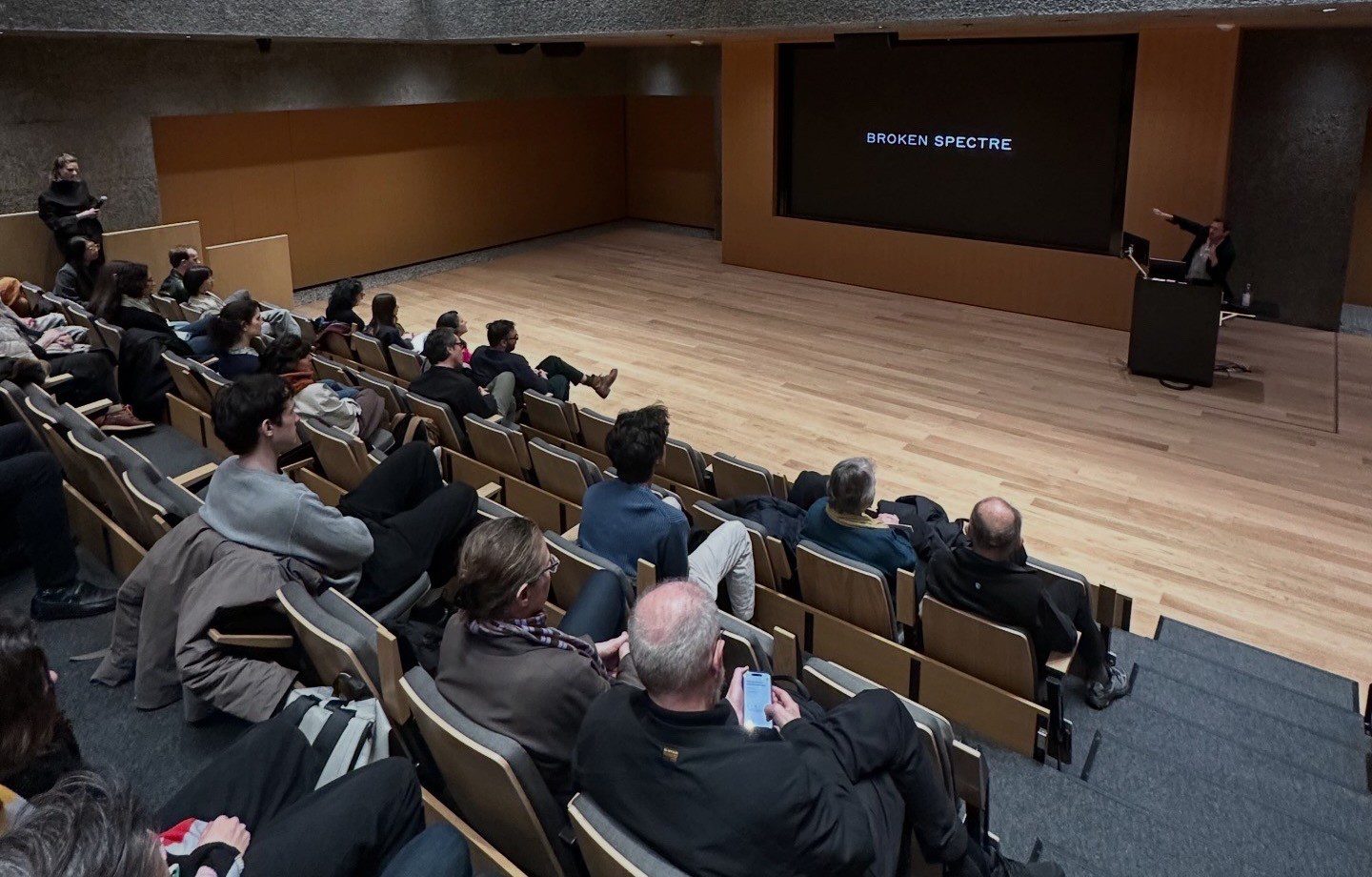
On Wednesday, February 25, in the Grand Hall of the Princeton University Art Museum (PUAM), Mosse screened and discussed Broken Spectre (2022). This film-based project leverages a range of image-making technologies to capture the devastating effect of deforestation in the Amazon. In it, Mosse employs multispectral aerial cameras and infrared analog film–some of the very same lens-based technologies used by corporations to survey and destroy the Rainforest–to instead trace human impact on the environment.
Mosse’s work routinely mobilizes a full range of contemporary image-making devices: drones, military-grade thermal imaging, multispectral cameras, and custom-built systems. The next day, Mosse led a lunchtime workshop to discuss his use of these devices with a small group of graduate students and faculty members. Participants from the Departments of Art & Archaeology, Architecture, Comparative Literature, Anthropology, Economics, German, and the PUAM engaged in a lively conversation with Mosse. While touching on topics related to extractive technologies, surveillance, and even map-making, Mosse reflected on the ever-present slipperiness of grasping the world through images.
Mosse’s visit was made possible by the Princeton Humanities Initiative’s focus on “Media & Meaning: Humanities in the World.” Additional support was provided by the Program in European Cultural Studies, the Graduate Program in Media+Modernity, the Brazil LAB, and the Department of Art & Archaeology, with special thanks to the Princeton University Art Museum.