

Imagine Otherwise: Fantasy, Fairytale, Fiction (Slavic Film Series) – New Gulliver
October 30, 2025 · 7:00 pm—9:30 pm · 301 Julis Romo Rabinowitz
Department of Slavic Languages and Literatures; REEES; Media and Modernity; European Cultural Studies; Humanities Council


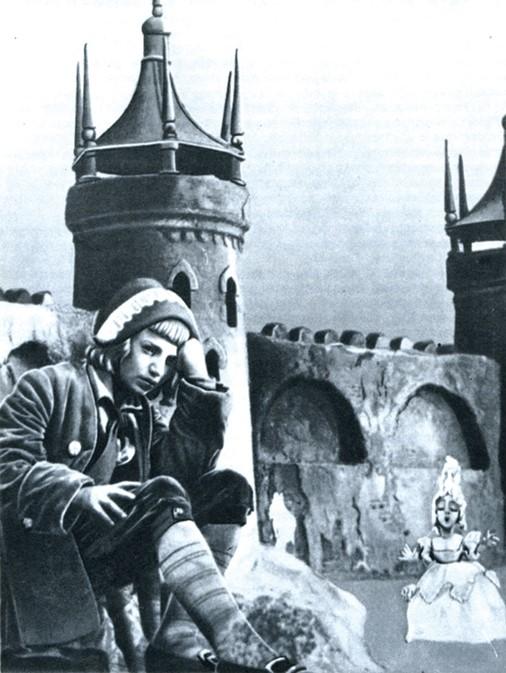
New Gulliver (dir. Aleksandr Ptushko, 1935, 75 min)
One of the first feature films to extensively utilize stop-motion puppet animation, New Gulliver is a Communist re-telling of Jonathan Swift. Petya, a pioneer from Artek, falls asleep while reading Gulliver’s Travels and finds himself in a dreamscape where Swift’s Lilliputia has been rendered as a capitalist-military state. Petya becomes involved in a worker’s strike, where his notebook from the Soviet Union informs the laborers of Lilliputia of the international solidarity of the proletariat.
The film, which was highly admired by Charlie Chaplin and additionally the founders of Czech animation, represents a highly productive Soviet translation of the Western fantasy genre. What is aimed for in the translation is not a one-to-one mapping between different cultural contexts, but a poetic inscription of difference at the moment of transposition.
_________________________________
The Soviet project was characterized by a utopian drive that stretched far beyond the material means at their disposal. Such a desire, uninhibited by ontological strictures, finds some of its clearest manifestations in film, a medium that Siegfried Kracauer once called “the daydream of society.” Consequently, this film series explores the way in which the social imaginary developed in Soviet (and Post-Soviet) cinema, particularly through the lens of fantasy, fairytale and science fiction. The aim of the series, however, is not to expose the incommensurable distance between a fallacious imagination and empirical reality, but rather to focus on the discourses of the possible – and not the factual – which have made cinema a privileged site for imagining how our world could be radically otherwise.
The series has been organized into four sub-series which allow us to explore different facets of this social imaginary. The first three films in the series (Aelita, Moscow-Cassiopeia, and First on the Moon) probe the Soviet Union’s cosmic imagination. Long before the Soviet Space Program, Nikolai Fyodorov’s biocosmism had captured the imagination of many radical thinkers. Aelita, one of the first full-length films depicting space travel, gave concrete imagery to these thinkers’ theories with Isaac Rabinovich and Victor Simov’s constructivist set designs of Martian society. The following films in this sub-series show the diachronic development of the sci-fi aesthetic, through the years following the Space Race (Moscow-Cassiopeia) and into the retrofitting historicization of the post-soviet perspective (First on the Moon).
The second sub-series (Amphibian Man and Professor Dowell’s Testament) focuses on the concept of the New Human in the new Soviet society. These films construct a laboratory – inhabited by animal-human hybrids and reanimated human heads – to think past the human and explore the potential consequences of such a posthumanist leap.
The third sub-series (New Gulliver, Alice in Wonderland, and Tale of Tales) centers on animation as another method of thinking beyond the real. This sub-series also articulates temporal and geo-spatial adaptations as two distinct ways of creating the new – while New Gulliver and Alice in Wonderland both represent the Soviet Union’s attempt to translate Western tales to Soviet contexts, Tale of Tales is an attempt to treat the Soviet past as material for fairytale narrativization.
Land of Oz and Mermaid, the films which constitute the last sub-series, similarly narrativize the real world through the epistemological framework of the fairytale. Here, however, the ideological explanatory functions of the Soviet Union have already faded away, and one must cling to the fairytale not to tell stories about the past, but to interpret the chaos of the present post-Soviet space. Events:
October 9th
Amphibian Man (dir. Vladimir Chebotaryov,1962, 82 min)
October 23rd
Professor Dowell’s Testament (dir. Leonid Menaker, 1984, 91 min)
October 30th
New Gulliver (dir. Aleksandr Ptushko, 1935, 75 min)
November 6th
Alice in Wonderland (dir. Efrem Pruzhanskiy, 1981, 31 min) & Tale of Tales (dir. Yuri Norstein, 1979, 29 min)
November 13th
Land of Oz (dir. Vasily Sigarev, 2015, 100 min)
December 4th
Mermaid (dir. Anna Melikyan, 2007, 115 min)