

Bridging insights from history, politics, culture, and the arts, the new minor in European Studies (EUS) invites undergraduate students from across disciplines to explore ideas that have shaped Europe’s past and present.
The minor, offered jointly by the Humanities Council’s Program in European Cultural Studies (ECS) and PIIRS’ Program in Contemporary European Politics and Society (EPS), is open to students in the Class of 2026 and beyond. The program of study is overseen by ECS Director Spyros Papapetros (Architecture) and EPS Director Harold James (History and SPIA).
“In no other program at Princeton can students experience such a unique blending of the study of humanities, including literature, music, art, and architecture, with an equally informed knowledge of European history, economy, and politics,” said Papapetros. “Our interdisciplinary seminars bring together a highly original mix of students from European language [programs], social sciences, and science departments with a common interest in current socio-cultural debates.”
The minor provides a comprehensive, global study of Europe – historically and synchronically – giving students the opportunity to cover a wide array of time periods and interests, with a focus on interdisciplinarity.
“Some of our students focus on contemporary politics, history and economics, and they learn the lesson that these areas are not only intrinsically interconnected, but also impossible to grasp without a deep understanding of cultural, intellectual and social particularities,” said James.
Abby Lu ’26, a Princeton School of Public and International Affairs (SPIA) major, is pursuing minors in both history and European studies.
“I decided to pursue [the EUS minor] to further my interests in post-communist Eastern Europe,” Lu said. “My participation in the coursework and excursions have allowed me to gain a more systemic understanding of the cultural dimensions of resilience, including poetry, popular resistance, and the arts, which complimented my studies on political institutions through SPIA.”
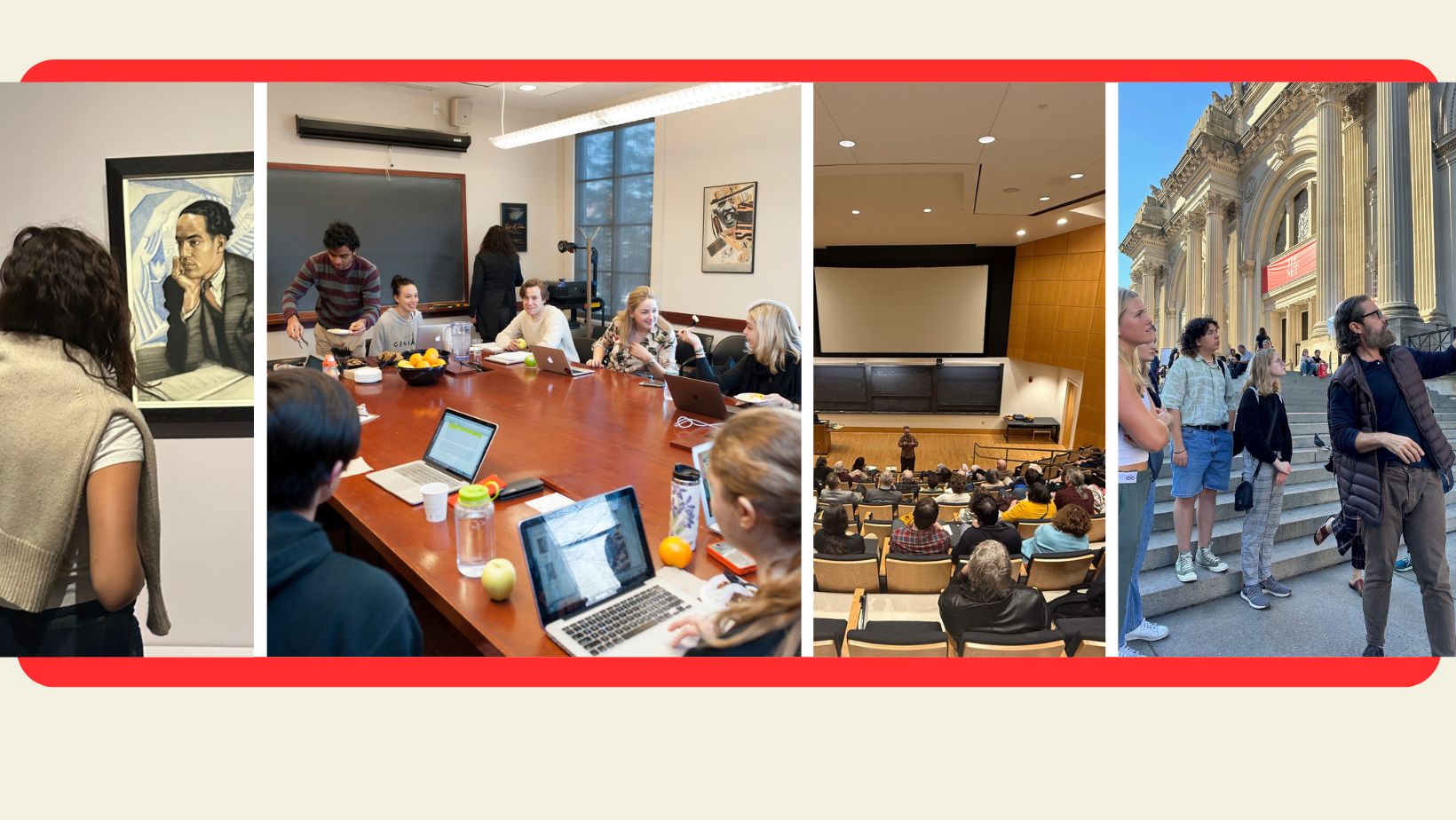
Through required coursework and excursions, students explore Europe’s rich history and enduring global significance and engage critically with current scholarship and study social, political, economic, and cultural trends relevant to the world at large. In the classroom, students can examine topics in European history, literature, art, architecture, music, cinema, theater, politics, sociology, economy, and philosophy.
Andrei Iosifescu ’26 is majoring in history and pursuing minors in EUS, humanistic studies, and medieval studies. He said that his minor coursework “has been an undeniable highlight” of his time at Princeton, citing courses taught by James, Iryna Vushko, Kim Lane Scheppele, David Cannadine, and Rubén Gallo as particularly “inspiring and formative.”
“I cherish early memories of the Global Seminar in Vienna, taught by Professor Gallo, which simultaneously fostered my love of opera and enhanced my understanding of a cultural and political milieu that I am currently investigating in depth through my senior thesis,” Iosifescu said.
Students pursuing the minor in European studies complete additional requirements that foster connections with prominent and emerging scholars, as well as with each other. Program lectures and daylong cultural excursions – typically to New York City – help to create a vibrant community among EUS minors. Past excursions have taken students to the Metropolitan Opera and Museum of Art, the Brooklyn Academy of Music, and the Tenement Museum. Signature program lectures have featured talks from theater director Peter Sellars, French writer Édouard Louis, countertenor Anthony Roth Constanzo, and scholars Londa Schiebinger and Donna V. Jones. The next public lecture on February 19 will feature historian Dipesh Chakrabarty.
“EUS lectures, colloquia, and informal student meetings on key cultural and political themes offered incredible opportunities to learn from and build personal connections with scholars and practitioners alike,” Iosifescu said.
A distinctive feature of the program includes the EUS Senior Thesis Colloquium, where students gather to discuss their research and conceptualization, organization, and writing, under the supervision of the directors of the minor. The collaborative series aims to create esprit de corps among classmates, to offer a space for new and interesting ideas and synergies, and to help improve research communication through lively discussion and debate.
“Our undergraduate students also benefit from the mentorship they receive from doctoral candidates, who attend the colloquium as members of our graduate affiliates group and are matched with mentees with whom they share common research interests,” said Papapetros.
Students apply for the minor in European Studies as early as the spring of their sophomore year.
The Program in European Cultural Studies, supported by the Humanities Council, is one of the oldest humanities programs at Princeton. It was founded in 1975 on the joint initiative of faculty members in history, comparative literature, romance languages and literatures, politics and architecture, under the leadership of the eminent cultural historian Carl E. Schorske (1915–2015). While deeply invested in Europe’s history, the program is boldly exploring contemporary cultural and socio-political debates from an interdisciplinary methodological perspective. Committed since its founding to encouraging students’ engagement at an international level, ECS now also endeavors to situate the study of Europe in broader global contexts. This year, in celebration of the 50th Anniversary of ECS, the program is planning a series of lectures, workshops and an archival exhibition of documents from its long history on the Princeton campus, with a targeted opening event at the beginning of February and another workshop scheduled for the spring.
The Program in Contemporary European Politics and Society, a regional program within the Princeton Institute for International and Regional Studies (PIIRS), encourages the interdisciplinary study of modern Europe, with a particular focus on politics, economics and society in western and central Europe since World War I. It also funds the European Union Program at Princeton (EUPP), founded in 2004, which sponsors events and activities relating to the European Union, including an active seminar series, an annual research workshop, policy meetings, public commentary, visiting fellows, graduate and undergraduate student activities, a Senior Thesis prize, and formal partnerships with Humboldt University, Sciences Po, and the University of Geneva.